Industrial Security · Ontario
Caledon and Durham Break-Ins: Three Charged in OPP Investigation
Three people have been charged following alleged break-ins at industrial and commercial properties in Caledon and Durham Region, highlighting practical questions around asset tracking, CCTV coverage, alarm response and after-hours site security.
By David ·
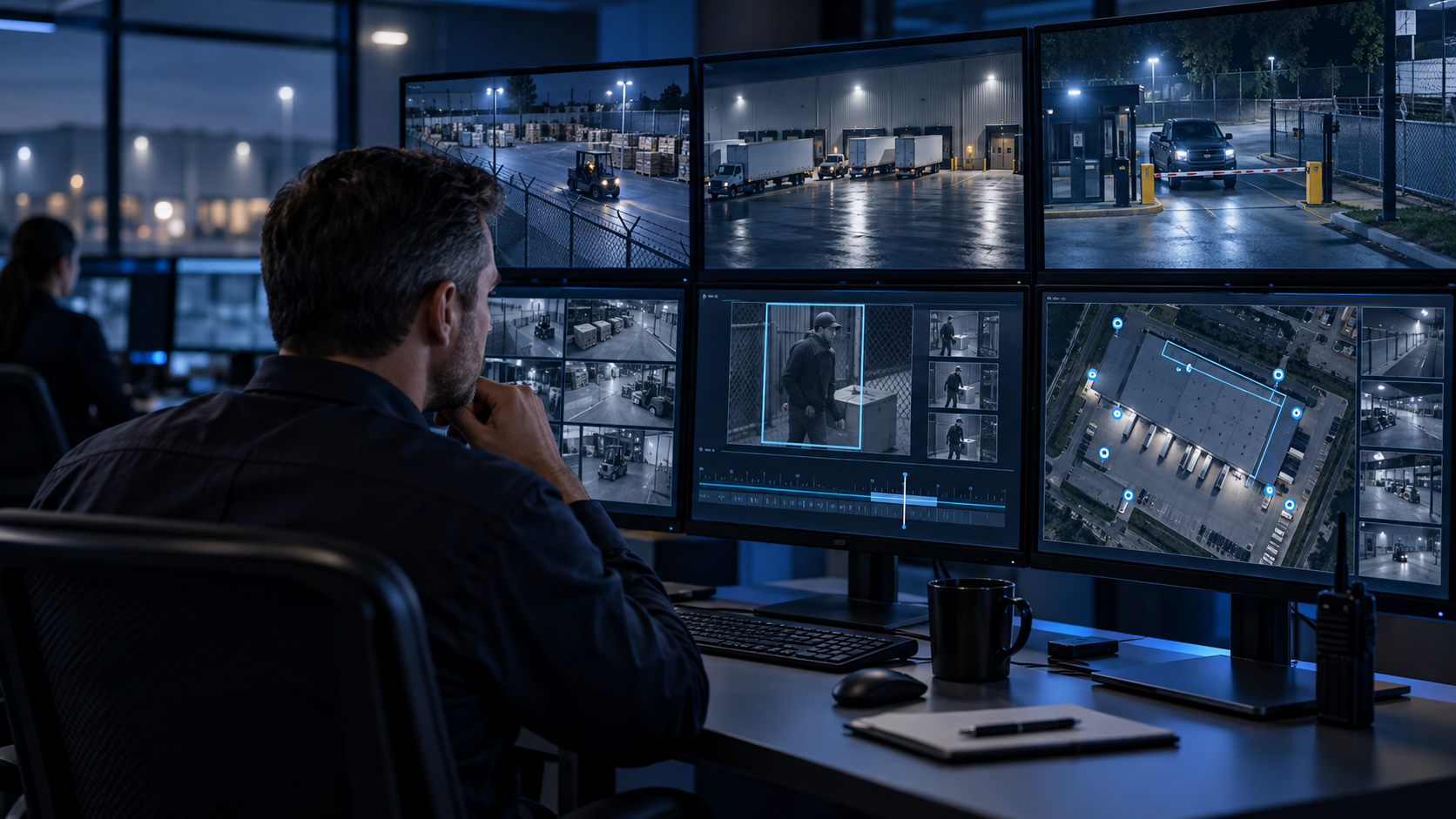
Three people have been charged following an Ontario Provincial Police investigation into alleged break-ins at industrial and commercial properties in Caledon and Durham Region.
According to police information reported by the Caledon Citizen, the alleged incidents occurred during the summer of 2026 and involved multiple industrial and commercial locations.
On September 10, Caledon’s Community Street Crime Unit, assisted by several other OPP units, executed search warrants at three Toronto addresses.
Police reported seizing two vehicles, numerous power tools described as stolen, and break-in instruments.
Three individuals were subsequently charged with offences including break and enter, theft over $5,000 and possession of property obtained by crime.
The charges have not been proven in court.
The published information does not identify the businesses involved, the precise methods allegedly used to gain entry, the security systems in place at the affected properties or the total value of losses.
For industrial and commercial property managers, however, incidents involving valuable equipment and after-hours access raise an important operational question:
If something happened at your property tonight, how quickly could your team determine what was missing, what was captured on camera and what happened next?
Asset Tracking: Can You Identify What Is Missing?
Industrial properties can contain hundreds of valuable portable assets, including power tools, testing equipment, machinery components and contractor-owned equipment.
When several similar pieces of equipment disappear, simply reporting “three drills were stolen” may provide limited information.
A stronger asset-management process can record:
- Manufacturer and model
- Serial number
- Internal asset identifier
- Photograph
- Ownership information
- Assigned employee or vehicle
- Normal storage location
- Last recorded location
The objective is not to create unnecessary administration around every inexpensive item.
Instead, businesses can prioritize equipment whose loss would create a significant financial or operational impact.
A useful internal test is simple: select several high-value assets at random and see whether staff can quickly retrieve their records.
If a business cannot determine exactly which item is missing, where it belonged or who last had responsibility for it, that process may deserve attention.
Perimeter Security: Make Closing Checks Meaningful
Industrial and commercial properties often contain multiple potential access points.
These may include:
- Main entrances
- Employee doors
- Shipping doors
- Loading docks
- Vehicle gates
- Rooftop access
- Exterior storage compounds
- Fenced yards
- Contractor entrances
A closing inspection therefore needs to provide more information than a simple entry stating that the site was secure.
A stronger closing record can document which areas were inspected, who completed the inspection, what time it occurred and whether any exception was discovered.
For example:
Weak entry:
“Site secure.”
More useful entry:
“East service-door latch found loose at 22:14. Supervisor notified. Temporary security measure implemented pending maintenance review.”
The second record gives the next supervisor or security officer something actionable.
It also creates a clearer trail showing when the issue was identified and what happened afterward.

Lighting and Visibility Around Industrial Properties
Exterior lighting is another important part of industrial security.
Proper lighting can improve visibility for guards and employees, reduce concealed areas around buildings and support camera systems.
Areas commonly worth reviewing include:
- Loading docks
- Employee parking areas
- Exterior storage
- Fence lines
- Vehicle gates
- Rear service doors
- Waste and recycling areas
- Trailer parking
Lighting should also be reviewed together with CCTV positioning.
A brightly illuminated property does not automatically provide useful surveillance footage if cameras face glare, important areas remain outside the field of view or nighttime image quality is poor.
The objective is not simply more light.
It is usable visibility.
CCTV: Test Whether Footage Can Actually Be Retrieved
Seeing a live image on a monitor does not necessarily mean a surveillance system is operationally ready for an investigation.
After an incident, security managers may need to determine:
- Which camera covered the location
- Whether recording was active
- How long footage is retained
- Whether timestamps are accurate
- Who has permission to retrieve recordings
- Whether footage can be exported
- How relevant evidence should be preserved
One useful test is to select a past 10-minute period and ask an authorized employee to retrieve it.
The employee should be able to identify the appropriate camera, locate the recording, export the footage and confirm that the exported file can actually be viewed.
This type of exercise can reveal weaknesses that might otherwise remain hidden until a real incident occurs.
A company may have dozens of functioning cameras but still face difficulties if only one employee knows how to retrieve footage.
Loading Docks Can Create Unique Security Challenges
Loading docks are particularly complex because employees, drivers, contractors, trailers and merchandise may all move through the same area.
That creates several possible security gaps.
Industrial security teams may want to review:
- Camera coverage of loading areas
- Trailer parking controls
- Driver and contractor sign-in procedures
- Door status monitoring
- After-hours deliveries
- Credential and key control
- Unattended merchandise
- Exterior lighting
- Employee-only areas
Loading-dock activity should also be connected to incident reporting.
If an unfamiliar vehicle appears repeatedly at a property, security teams should be able to determine whether similar observations were reported by another shift or at another location.
Alarm Response: What Happens After the Alert?
Installing an intrusion alarm is only part of an effective response process.
Property managers should understand what happens after an alarm is triggered.
Important questions include:
Who receives the first notification?
Is the system professionally monitored?
Can the event be verified through CCTV?
Who is the primary keyholder?
Who is the backup contact?
Can someone access cameras remotely?
When does the situation escalate?
What happens if nobody answers?
Contact information also needs regular review.
A technically functioning alarm system can still create operational problems if notifications are being sent to employees who have changed roles or left the organization.
Patrols Should Record Exceptions, Not Just Presence
Security patrols can provide considerably more value when they document changing conditions rather than simply confirming that a guard visited a location.
Useful observations may include:
- Open or unsecured doors
- Damaged fencing
- Lighting failures
- Unfamiliar vehicles
- Unsecured equipment
- Alarm trouble conditions
- Evidence of attempted entry
- Suspicious activity
A useful security workflow connects:
Observation → Report → Escalation → Corrective Action → Confirmation
For example, discovering damaged fencing is only the first step.
The organization should also know who was notified, whether temporary controls were introduced, whether repairs were requested and whether someone later confirmed that the issue had been resolved.
That information becomes particularly important during shift changes.
Contractor and Visitor Access
Industrial facilities can have significant numbers of contractors and visitors entering areas not normally accessible to the public.
Maintenance contractors, electricians, delivery drivers, cleaning staff and temporary workers may all require different levels of access.
Depending on the property and its requirements, visitor or contractor records may include:
- Name
- Company
- Arrival time
- Departure time
- Host
- Purpose of visit
- Authorized area
- Credential issued
- Vehicle information where appropriate
The objective is not unnecessary monitoring.
It is to maintain a reliable record of who was authorized to enter the property and when.
Multi-Site Companies Need Consistent Incident Reporting
Organizations operating several warehouses, commercial buildings or industrial sites can face another problem: each location may report incidents differently.
One property may produce detailed incident reports.
Another may rely on email.
Another may record information in handwritten logs.
That inconsistency can make it difficult for management to compare events across locations.
A standardized incident report can include:
- Date and time
- Property
- Incident category
- Assets affected
- Objective observations
- Photographs or video references
- Responding personnel
- Police occurrence number when applicable
- Follow-up actions
Consistent reporting does not mean automatically assuming that similar incidents are connected.
It simply makes information easier to review.
Avoid Turning Observations Into Conclusions
Security teams also need to distinguish between what was observed and what is suspected.
For example:
Observed fact:
“A dark pickup truck entered the west parking area at approximately 1:18 a.m.”
Interpretation:
“The vehicle may have been connected to a previous theft.”
These are not the same thing.
Reports should clearly separate objective observations from assumptions or investigative conclusions.
That makes security documentation more useful and reduces the risk of unsupported allegations.
Eight Questions Industrial Sites Can Review Now
The Caledon and Durham investigation provides a useful opportunity for industrial and commercial property managers to review their own operations.
Consider asking:
- Can we identify our most valuable portable equipment?
- Are doors, gates and storage areas included in documented closing checks?
- Do our cameras provide usable coverage of high-risk locations?
- Can authorized staff retrieve surveillance footage outside normal office hours?
- Do we know exactly what happens when an alarm activates?
- Are after-hours patrols documenting exceptions and follow-up actions?
- Are contractor and visitor records consistent?
- Can incidents from different properties be compared using the same reporting structure?
If several of those questions produce unclear answers, the issue may not necessarily be a lack of security equipment.
It may be a lack of operational process.
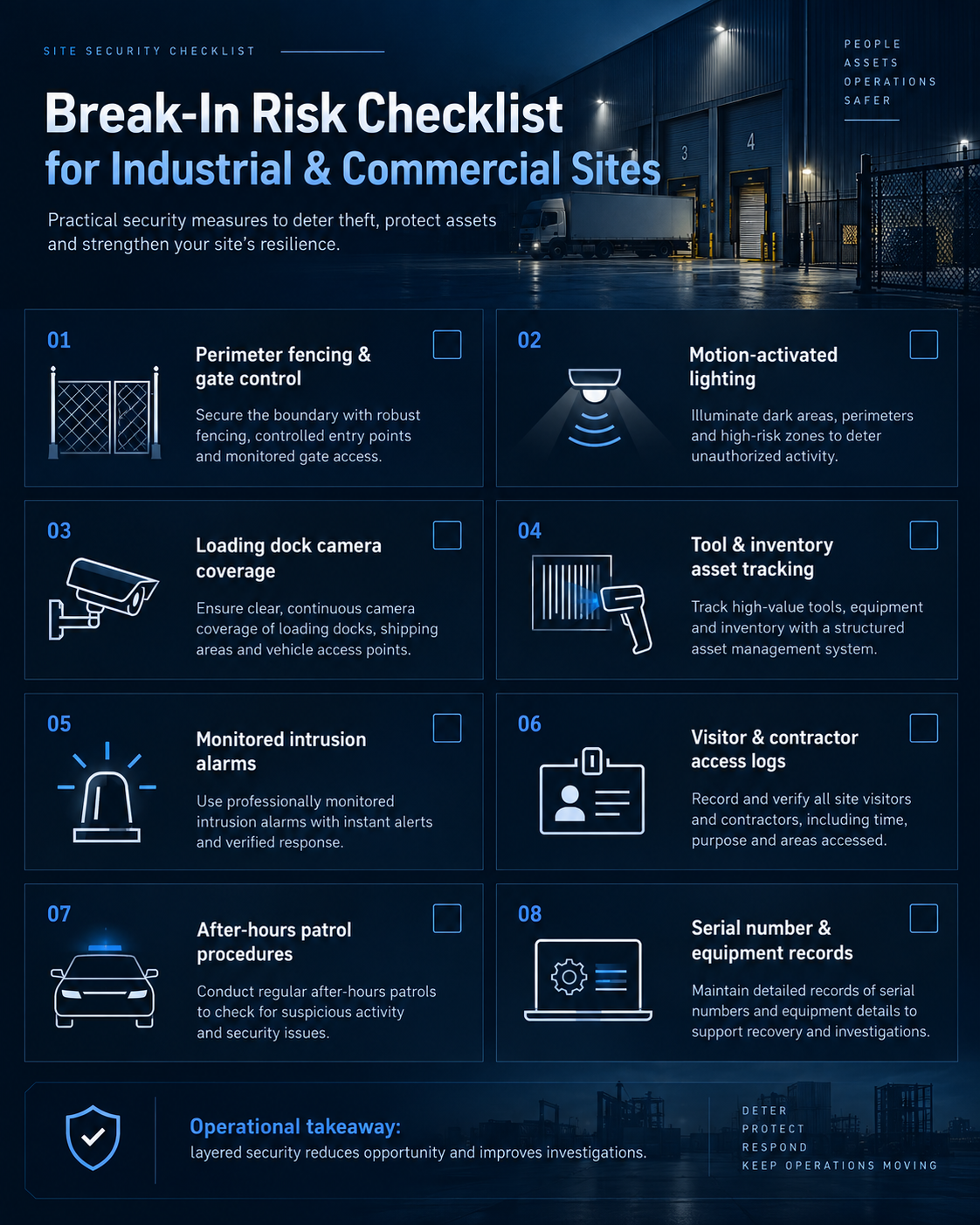
The companion checklist brings together eight controls: perimeter fencing and gates; motion-activated lighting; loading-dock camera coverage; tool and inventory tracking; monitored intrusion alarms; visitor and contractor access logs; after-hours patrol procedures; and serial-number records.
The Bigger Lesson for Industrial Security
The Caledon and Durham investigation remains primarily a police and court matter, and the allegations against the accused have not been proven.
For security professionals, however, incidents involving commercial properties and valuable equipment can also provide an opportunity to review how their own sites operate.
Effective industrial security typically relies on several layers working together:
Perimeter controls → Lighting → CCTV → Alarms → Patrols → Asset records → Incident reporting → Follow-up
No individual layer eliminates risk.
The value comes from having people, processes and technology that support one another.
For industrial and commercial operators, one of the most useful questions may therefore be straightforward:
If something happened at your site tonight, could your team clearly show what was secured, what changed, what was recorded and what happened next?