Critical Infrastructure · Alberta
Alberta’s Lithium Projects Are Redrawing the Mining Security Perimeter
Alberta’s emerging lithium industry is creating a new kind of mining security challenge. Distributed wells, pipelines, processing systems, contractors and operational technology are pushing security teams beyond the traditional fence-and-gate model.
By Canadian Security Intelligence Staff ·
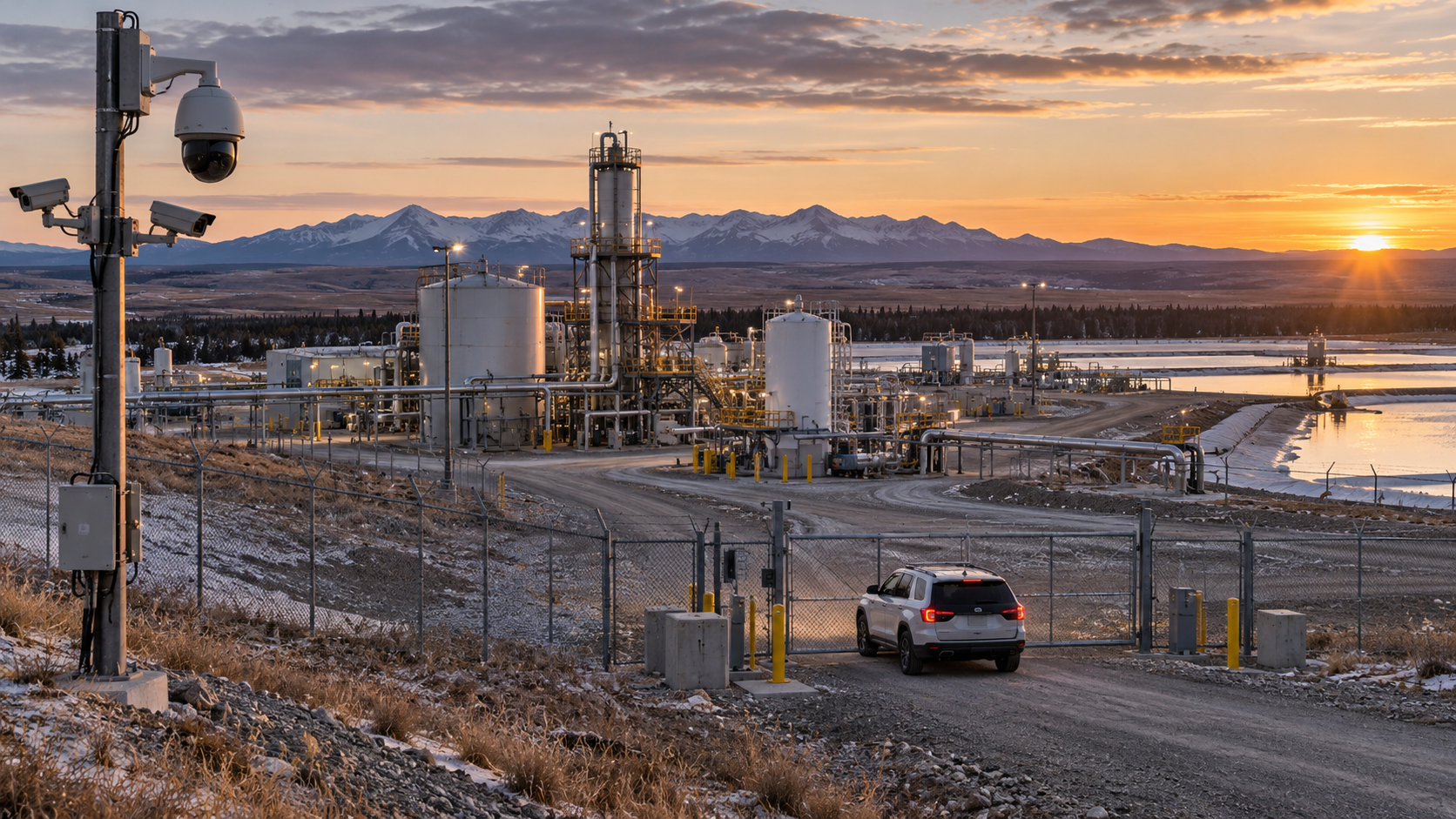
Alberta’s next generation of mineral operations may not look much like the mines security teams are accustomed to protecting.
The province has substantial lithium resources contained in underground brines, and several projects are moving through demonstration, engineering and commercial-development stages. The Alberta Geological Survey estimated in 2026 that Devonian brines across the province contain approximately 82.5 million tonnes of lithium carbonate equivalent in place. That figure represents lithium estimated within the geological formations, not 82.5 million tonnes of economically recoverable reserves, but it illustrates the scale of the resource being evaluated.
At the same time, the Alberta Energy Regulator says the province currently has no commercial lithium production. Its September 2026 outlook anticipates E3 Lithium and NeoLithica beginning commercial production in 2028 and LithiumBank’s Boardwalk project beginning in 2029, subject to project development progressing as planned.
For Alberta’s security industry, the opportunity is easy to overlook.
Lithium development is not simply another mining story.
It is potentially a new security architecture problem.
Instead of protecting a single mine surrounded by a clearly defined perimeter, operators may need to secure networks of wells, pipelines, processing equipment, contractors, communications infrastructure and operational technology spread across large areas.
That changes what Alberta mining security looks like.
The Traditional Mine Perimeter Is Starting to Disappear
Conventional mine security is often built around a straightforward principle: secure the perimeter and control the points where people, vehicles and materials enter or leave.
There may be kilometres of fencing, but operational control still tends to converge around recognizable areas: gates, processing plants, maintenance facilities, warehouses, fuel storage and administrative buildings.
Brine-based lithium extraction can create a different footprint.
E3 Lithium’s Clearwater development illustrates how that footprint can evolve. The company’s demonstration program has included production and injection wells, lithium-processing equipment and work intended to inform the design of a future well and pipeline network. Its September 29 project update said Phase 2 of the demonstration facility was nearing completion while development of a commercial-scale direct lithium extraction column and further engineering continued.
From a security perspective, each element can become an asset requiring protection.
A commercial operation could eventually include:
production wells;
injection wells;
pipelines and gathering infrastructure;
electrical systems;
communications cabinets;
pumping equipment;
chemical storage;
processing facilities;
laboratories;
control rooms;
product storage;
contractor staging areas; and
remote access systems.
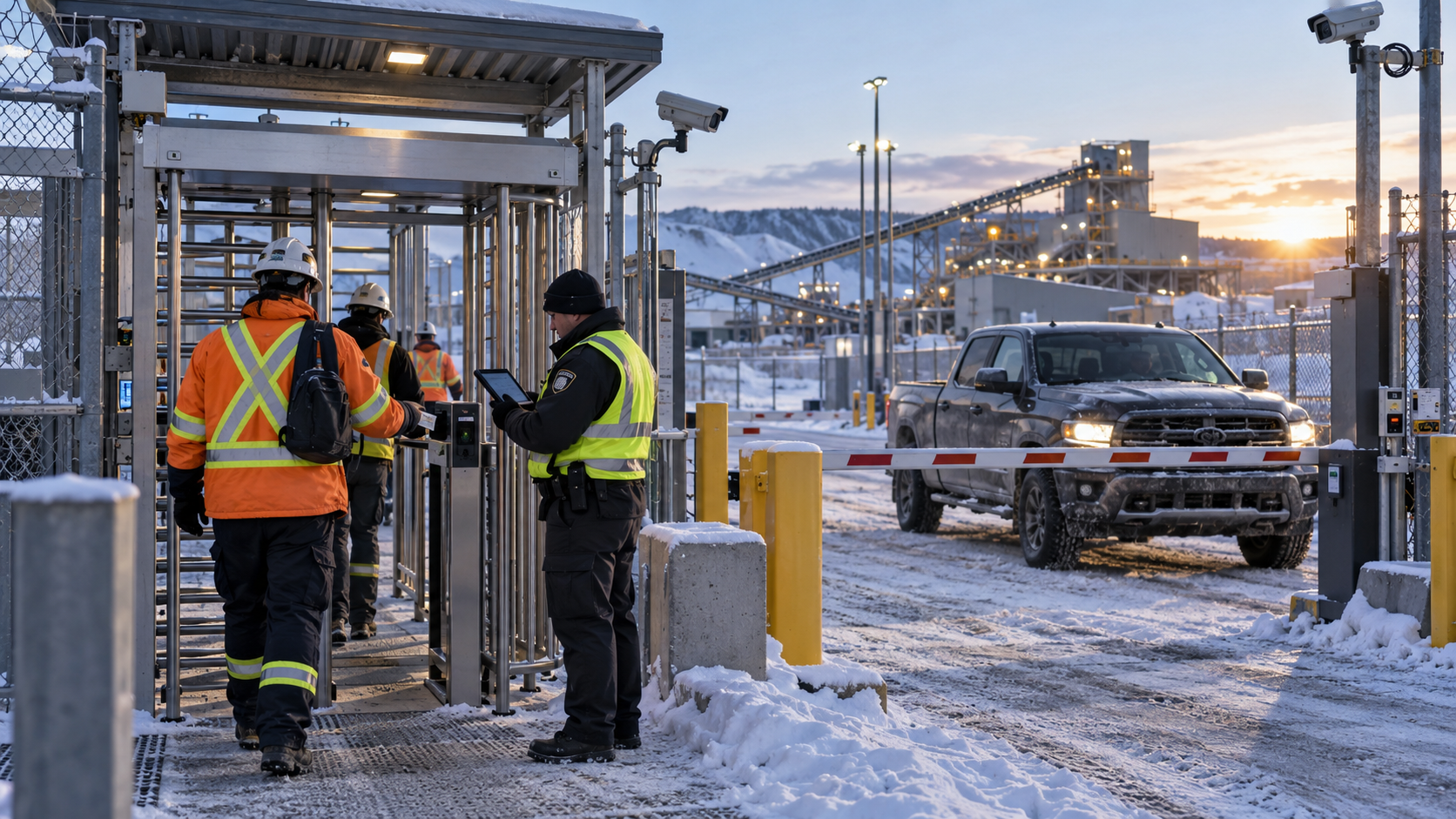
The security perimeter therefore becomes less of a line around a facility and more of a network of protected nodes.
That distinction matters.
An intruder may never approach the main gate if a remote installation provides an easier target.
Alberta Mining Security Is Becoming a Remote-Site Problem
Distance is one of the most important variables in industrial security.
At an urban facility, an alarm can often be investigated within minutes.
At an isolated well pad or industrial installation, a mobile response unit could be much farther away.
That makes detection quality more important.
A camera that records an incident but does not generate a useful alert may provide excellent evidence afterward while doing almost nothing to change the outcome.
Likewise, poorly tuned analytics can become expensive if operators repeatedly dispatch patrol vehicles to investigate wildlife, weather conditions or equipment movement.
Remote mining and resource sites should therefore be designed around verified detection.
A mature configuration might combine:
fixed surveillance cameras;
thermal cameras where conditions justify them;
intelligent video analytics;
gate and cabinet tamper alarms;
perimeter intrusion detection;
remote intercoms;
automatic licence-plate recognition at controlled entrances;
environmental monitoring;
reliable backup communications; and
a defined mobile-response procedure.
The objective is not simply to generate an alarm.
The objective is to give the security operations centre enough information to answer the first important question:
What is actually happening?
Is the movement wildlife?
Is it an authorized technician arriving early?
Is someone attempting to access equipment?
Has a cabinet been opened during scheduled maintenance?
Or is the security event occurring at the same time as an unusual operational or cyber event?
That last possibility is increasingly important.
Physical Security and OT Cybersecurity Are Converging
Mining security can no longer be separated cleanly into guards on one side and cybersecurity professionals on the other.
Modern industrial facilities depend heavily on operational technology, or OT: the systems used to monitor and control equipment and physical processes.
The Canadian Centre for Cyber Security specifically identifies resource extraction as one of the sectors where OT is extensively used. It has warned that threat actors can target poorly secured internet-accessible industrial systems and that insecure remote access and weak credentials can create opportunities for disruption.
The Cyber Centre recommends measures including isolating OT where practical, securing remote access, changing default credentials, segmenting IT and OT networks and maintaining the ability to operate critical systems manually when necessary.
Those are cybersecurity controls.
But consider what happens when they overlap with physical security.
At 2:11 a.m., an access-controlled door opens at a process building.
At 2:14 a.m., a privileged account attempts to connect to an industrial system.
At 2:16 a.m., the security operations centre receives an equipment alarm.
Three departments could see three unrelated events.
Or one integrated security program could recognize one developing incident.
That is why mining operators increasingly need the ability to correlate:
access control + video + contractor records + network events + OT alarms + guard observations.
The individual technologies already exist.
The more difficult challenge is getting them to produce a coherent operational picture.
Contractor Access Could Become One of the Largest Security Gaps
Rapidly developing resource projects can create an enormous contractor population.
Engineering firms, electricians, drilling crews, equipment manufacturers, automation specialists, environmental consultants and maintenance contractors may all need temporary access.
Traditional badge administration can become dangerous when temporary access gradually turns into permanent access.
A contractor who needed a processing-area credential six months ago may still have it.
A vendor authorized for one building may receive credentials covering the entire site.
A terminated contract may close the purchase order while leaving physical or digital credentials active.
For an emerging lithium operation, access should ideally be assigned according to four variables:
Who is the person? Where do they need to go? What are they authorized to do? How long should that access exist?
Temporary credentials should automatically expire.
Access should follow operational need rather than employment category.
Someone servicing pumping equipment at a remote well does not automatically need access to product storage.
A controls contractor entering a processing building does not necessarily require unrestricted movement through administrative areas.
Vehicle authorization should also be considered separately from personnel authorization.
This is particularly important for geographically distributed projects because vehicles may become the primary way workers and contractors move between protected assets.
Access Data Should Be Treated as Security Intelligence
Modern access control should do more than unlock a gate.
It should help an operator understand activity across the site.
Consider a remote installation where an equipment cabinet is opened unexpectedly.
An effective security system should allow an operator to answer:
Who is currently authorized at that location?
Which contractors are scheduled there today?
Did a vehicle enter the access road?
Which credential was last used?
Is there corresponding video?
Was a maintenance ticket active?
Has there been unusual activity at neighbouring sites?
Were any OT or communications alarms recorded at the same time?
That transforms access control from an administrative system into an investigative tool.
For large resource projects, the quality of this information can determine whether an incident takes minutes or hours to understand.
Lithium Projects Also Create an Information-Security Problem
Security teams should not focus exclusively on equipment.
Early-stage critical-mineral projects generate valuable information.
Reservoir data.
Process results.
Engineering designs.
Flow characteristics.
Equipment configurations.
Pilot-plant results.
Commercial production assumptions.
Samples.
Vendor information.
E3 Lithium, for example, says data produced through its Clearwater demonstration facility is being used to support engineering, feasibility work, financing discussions and future commercial development. The company is also expanding its DLE demonstration work with a commercial-scale column intended to generate further technical and operating information.
From a security perspective, that means valuable assets can leave the facility without leaving in a truck.
Organizations should consider how project information is accessed by employees, consultants and contractors, particularly when those users connect remotely or work for multiple resource companies.
Physical and digital controls therefore need to overlap.
A highly protected laboratory means little if its data can be copied without meaningful controls.
Likewise, a heavily segmented network does not eliminate risk if an unauthorized individual can simply enter the equipment room.
Security Technology Has to Work in an Alberta Winter
Environmental conditions are another reason generic security designs can fail.
Remote Alberta sites can face snow, ice, fog, wind, extreme temperatures, limited daylight and large changes in seasonal lighting.
Those conditions affect cameras, sensors, gates, roads, batteries and communications systems.
Snow can change a camera scene dramatically.
Wind-driven vegetation can create analytics alarms.
Ice can interfere with mechanical equipment.
A camera mounted correctly in July may produce a very different field of view after snow accumulation.
Security system testing should therefore include environmental performance, not simply installation acceptance.
Operators deploying video analytics should measure false alarms under real site conditions.
Remote equipment should also be designed with maintenance accessibility in mind.
A sophisticated sensor is not particularly useful if technicians cannot safely reach it when it fails in February.
Response Time Should Determine the Security Design
One of the most useful metrics for a remote mine or resource operation is not camera resolution.
It is response time.
Suppose a remote asset is 35 minutes from the closest patrol unit.
The security architecture should be designed around what can happen during those 35 minutes.
Can the event be verified remotely?
Can operators communicate with the individual?
Can another camera track movement?
Can sensitive equipment be electronically isolated?
Can nearby personnel be warned?
Can access gates be controlled remotely?
Can video and access records be preserved immediately?
Security technology should buy the response team information and time.
That is more valuable than simply recording better footage of an event that nobody knew was happening.
Mining Security Should Be Designed Before the Mine
Perhaps the largest opportunity for Alberta security professionals is timing.
The province’s lithium sector is still developing.
The AER’s September 2026 outlook says Alberta has no commercial lithium production today, while several projects are targeting production later in the decade.
That means much of the permanent infrastructure has not yet been built.
For security teams, that is an advantage.
Security is significantly easier to engineer into a project than retrofit afterward.
During design, operators can still influence:
gate placement;
fencing transitions;
camera sightlines;
equipment-room access;
communications redundancy;
secure network-cabinet locations;
vehicle inspection areas;
lighting;
guard facilities;
emergency routes;
visitor processing;
contractor staging areas; and
secure product storage.
Once roads, buildings and utilities have been constructed, many of those decisions become expensive to change.
Security professionals should therefore be involved during front-end engineering rather than arriving shortly before commissioning.
A Five-Layer Security Model for Alberta Lithium Operations
For operators developing a new project, a practical baseline can be built around five connected layers.
- Asset Visibility
Know what has to be protected.
Create a security map covering wells, buildings, pipelines, communications infrastructure, control systems, storage areas and other critical assets.
- Identity and Access
Know who is allowed near those assets.
Credentials should be linked to individuals, vehicles, roles, locations and defined time periods.
- Detection and Verification
Know when something abnormal is happening.
Use appropriately selected cameras, sensors, analytics and monitoring systems to detect credible activity while controlling nuisance alarms.
- Integrated Incident Intelligence
Know whether separate events are connected.
Physical-security events, access records, video, OT alarms and cyber alerts should be capable of being viewed on a common incident timeline.
- Response and Evidence
Know what happens next.
Every meaningful alarm should have an owner, an escalation process and a method for preserving evidence.
These five layers provide a more useful measure of security maturity than the number of guards or cameras deployed.
What This Means for Alberta Security Companies
The emerging critical-minerals sector could create an important market for security integrators, guarding companies, monitoring providers and security consultants.
But winning that work may require a different offering.
A proposal centred entirely on guard hours is unlikely to address the whole risk.
Neither is a proposal centred entirely on CCTV.
The strongest security model combines:
physical security;
electronic security;
access management;
remote monitoring;
mobile response;
contractor management;
operational technology awareness; and
incident intelligence.
This also creates opportunities for security providers that understand Alberta’s existing oil and gas infrastructure.
Lithium-brine operations share characteristics with both mining and energy production.
The security provider capable of operating across those two worlds may have an advantage as the sector develops.
Alberta Has a Window to Build Security In From the Beginning
Alberta’s lithium industry is not yet operating at commercial scale.
That is precisely what makes the current period important for security.
The geological opportunity is substantial: the Alberta Geological Survey estimates 82.5 million tonnes of lithium carbonate equivalent in place within Devonian brines.
The development pipeline is advancing: the AER now forecasts initial commercial production from several projects toward the end of the decade.
And companies such as E3 Lithium are already progressing through demonstration, engineering and commercial-scale process development.
For the security industry, the question should not be how to secure these facilities after they are built.
It should be:
What should a secure Alberta lithium operation look like before construction is finished?
The answer will require more than gates and cameras.
It will require a security architecture built around distributed assets, remote operations, contractors, industrial control systems and the ability to connect physical and digital events in real time.
Alberta’s lithium industry may still be emerging.
Its security model should not be.
Frequently Asked Questions
What are the biggest security risks for lithium projects in Alberta?
Key areas for operators to consider include unauthorized access to remote facilities, theft or vandalism of equipment, contractor credential management, cyber risks involving operational technology, communications failures, protection of sensitive technical information and slow response times at isolated assets.
The appropriate controls depend on the design and risk profile of each individual project.
Why is remote-site security important for Alberta mining operations?
Mining and resource infrastructure can be distributed across large geographic areas. Remote locations may have fewer personnel nearby and longer emergency or security-response times, which increases the importance of reliable detection, remote verification and clearly defined escalation procedures.
What is OT security in mining?
Operational technology security protects the industrial systems used to monitor or control physical equipment and processes. In mining and resource extraction, OT can include controllers, sensors, pumps, industrial networks, process equipment and supervisory systems.
The Canadian Centre for Cyber Security recommends measures including IT/OT segmentation, secured remote access and minimizing direct internet exposure of OT systems.
Why should physical security and cybersecurity teams work together?
An incident can cross both environments.
Unauthorized physical access could provide an attacker with direct access to industrial equipment, while a cyber event could affect physical processes.
Combining access-control records, surveillance, OT events and cyber alerts can help operators determine whether apparently separate anomalies are part of the same incident.
When should security planning begin for a new mining project?
Ideally, during engineering and site planning.
Early security involvement makes it easier to optimize gates, fencing, surveillance locations, communications, equipment rooms, network architecture and emergency-response routes before construction decisions become difficult or costly to change.